Association
Lincoln Red
Of North America
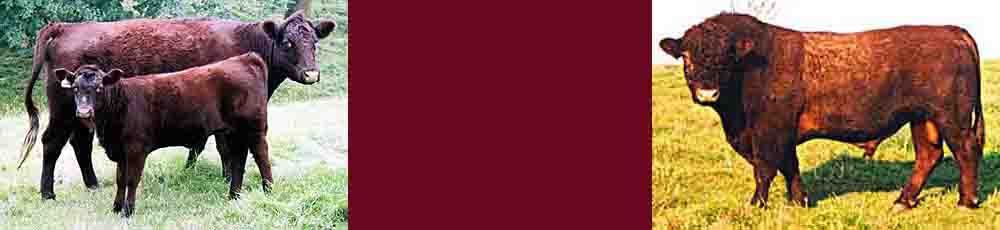
In the late 18th and 19th century, select bulls from Durham and York were crossed with these native Lincolnshire cattle and the resultant progeny became known as the Lincoln Red. In 1799, the British Board of Agriculture described the Lincoln Red as “a breed of cattle which is unsurpassed in this country for their disposition at any age to finish rapidly.” This breed was recognized in the first Coates Herd Book in 1822 and the Lincoln Red Association subsequently was formed in 1896.
In 1964 Dr. Shaver imported some of the first Lincoln Red cows to Canada. The largest of the cows, Driby 325 tipped the scale at a delicate 1925 lbs. Her son, Camson Pandrama grew to an enormous 2900 lbs. Following are Dr. Shaver’s comments regarding why he decided to import the Lincoln Red. . .
From;
Donald McQ. Shaver, O.C., D.Sc.
"My cattle breeding activities were
profoundly influenced by experience as a primary
international poultry breeder. As a boy of 15 I had won
the Canadian Egg Laying contest, which was open to
competitors from around the world. This winning pen of
layers was the result of crossing two unrelated strains
of layers, and capturing the full economic benefits of
heterosis. This discovery was quite by accident. For a
few years different crosses were made, but none
performed as spectacularly as that first cross. In other
words, I
learned that you simply couldn't make any cross and
produce a winner.
The next step was to set up a test structure capable of
assessing multiple crosses, simultaneously. Annually we
tested 30 different
crosses, and over time it became clear that a very few
strains were exceptional. We found two that regardless
of how they were crossed, their progeny would perform
significantly above average. When these two lines were
crossed, we had the combination that took our name
around the world.
I reasoned that this same procedure applied to other
species, would likely also express thee benefits of
heterosis. I searched the world
for cattle breeds that were likely to be unrelated to
the main beef stocks in North America, which at the time
were Hereford, Angus and Shorthorn. Breeds imported
included Charolais, Maine Anjou, Salers, Lincoln, North
and South Devon. Many others were identified, but for
health reasons were not importable.
In the countless breed crosses that were made, the
distinctive Lincoln emerged as the breed whose crosses
consistently performed above average, in economic terms.
The Lincoln was not a flashy breed of cattle, but they
were large, adapted to rugged conditions, easy to
handle, and possessed a coat of a pleasing red shade. Of
importance to me in the 1960"s was that genetically it
remained a closed (pure) population, that could be
traced back to Nordic invaders, and therefore probably
to the Russian steppes. Moreover, the traditional cattle
breeders of East Anglia had devoted themselves to
preserving the purity and rusticity of the Lincoln Red,
while steadily enhancing its growth rate.
Today, some of the purest stocks of the Lincoln Red
breed are located in North America. Our breeders in
Canada and in the USA recognized that they could not for
health reasons, rely on the regular importation of
breeding animals and semen from overseas sources.
In a move highly unusual in beef cattle breeding
circles, the members of the North American Lincoln Red
Association have banded together to jointly and
systematically preserve the genetic integrity of the
breed. Obviously, without this disciplined approach, the
limited number of foundation animals would quickly
degenerate into an inbred collection of dubious merit.
Instead, the breed's gene pool value has been enhanced
by the creation of several distinct new lines and this
process continues.
Beef cattle breeders who choose to utilize the Lincoln
Red as one of the key lines in their final crossbred
carcass animal will have
incorporated unparalleled rusticity, feed economy,
growth rate and heterzygosity (exceptional vigor)".
Association
Lincoln Red
Of North America